
| Issue 003 | Tuesday | 5 May 2026 |
On Serve
Sinner’s Madrid is a record. His Rome is the reason it matters.
Sinner beat Zverev 6-1, 6-2 in 58 minutes on Sunday afternoon. That settled Madrid. The bigger question — whether anyone on the men’s tour can give him a match between here and Roland Garros — Madrid did not settle, and now passes to Rome.
|
5
Sinner’s Consecutive Masters 1000 Titles — an Open-Era First
|
1
His Career Madrid Titles, Finally
|
6
What He Is Chasing This Week in Rome
|
Issue 002 said he had every reason to win it. The asterisks held: Alcaraz home with a wrist, Djokovic home with a shoulder, altitude favouring flat-hitters. Sinner walked out under the lights, broke once in the opening five games of the final, and was lifting the trophy under an hour later. Zverev had taken him to a third set in their previous meeting. He did not, on Sunday, take him to a tiebreak.
The streak now reads Paris-Bercy in November, Indian Wells in March, Miami the fortnight after, Monte-Carlo three weeks ago, Madrid on Sunday. Five Masters 1000s in a row, the first man to play five consecutive Masters and win them all. Djokovic won five in a row across the events he entered in 2014–15, but skipped a Madrid in between. Nobody has done what Sinner has now done. Nine career Masters titles, twenty-eighth tour title overall, twenty-three matches in a row since early March. The single set he dropped in Madrid came in the second round against Benjamin Bonzi. From the third round on he won in straight sets. The Spanish wildcard Rafael Jódar pushed him to a tiebreak in the quarters and was, at one hour and fifty-seven minutes, the only opponent who got near him.
What Madrid did not produce, and what Rome is being asked to, is the match. Alcaraz withdrew from the Foro Italico on Saturday — the wrist still not right — so the rivalry the spring was meant to settle gets postponed for a third event running. Sinner’s Rome draw, on paper, reads soft. Mensik in the third round. A serve-and-volley specialist or a tired Russian in the round of sixteen. Whoever survives the bottom half on the Friday before the final.
On present trajectory he arrives at Roland Garros with six Masters 1000s in a row and no real test of the run since Alcaraz in Monte-Carlo. The mythology is being built in real time. The man best positioned to interrupt it has not been on a tennis court for a month.
This is what dominance looks like when it goes uncontested.
On the strange pleasure of waiting for a result one already knows.
There is a kind of tennis fan — not the most romantic kind, but a recognisable kind — who follows the spring clay swing the way a churchgoer follows Lent. Not for the proceedings themselves, exactly, but for what the proceedings are building toward. Monte-Carlo is the first Sunday of palms. Madrid is the long midweek with the candles. Rome is the Saturday vigil. Roland Garros is the morning, and the question of whether Christ rises is, in this analogy, the question of whether the man who has won every tournament leading up to it can win the one that finally counts.
The trouble with the analogy is that the man who is going to win Roland Garros, this year, is also going to win Rome. Probably. And the man who was going to provide the dramatic counter-argument — the one whose presence in the draw was meant to make the whole season legible as a story, rather than a procession — has not played a competitive set since the second weekend of April. So the building toward is taking on a strange, hollow quality. We are still observing the rituals. There are highlights to watch on Sunday evening. There are press conferences in which the world No. 1 says, in good Italian, that he is happy to be home. But the question that is supposed to organise the whole spring — can anyone beat him? — is being shrugged off, not because the answer is yes, but because the man best positioned to provide a no is not, at the moment, well.
This is what tennis looks like, occasionally, when its dramaturgy fails. The schedule keeps producing tournaments, and the tournaments keep producing winners, and the winners keep producing trophies, and there is a complete, formally satisfactory record of the spring being constructed match by match. But the anticipation — that thing tennis traffics in more than any other sport, the slow uphill of the calendar toward Wimbledon and the slow downhill from it — has lost its grip. The slope flattens out. The mountain disappears in fog. We are watching, and there is nothing in particular to wait for.
What the genre survives on, in moments like this, is the fortnight at the back end. The one in Paris where any of it can still come undone. Where Sinner can pull a hamstring in the third set of a quarterfinal, or arrive ill-prepared because nothing on the spring forced him to be otherwise, or run into a 22-year-old who plays the match of his life on a Wednesday afternoon at Court Suzanne-Lenglen. Where Roig finishes — or fails to finish — what he started with Iga in the 27 days before the draw. Where Sabalenka decides, on her tenth attempt, that the dirt is finally for her. Where some impossible thing happens, because tennis still has the institutional memory to know that impossible things are what its slams are for.
In the meantime: we wait. We do the rituals. We watch Rome, and we tell ourselves the result there matters, and we say the words Roland Garros the way one says the name of a station one is looking forward to arriving at, three more stations down the line.
The waiting is not the worst of it. The waiting may, against expectation, prove to be the best.
Marta Kostyuk has been here longer than her trophy suggests.
She did a backflip on the clay after the final point. She is twenty-three. She has been on the WTA Tour, in some form, since she was fifteen.
Kostyuk won the Australian Open junior title at fourteen and turned pro at fifteen. Her progress since then has been steady rather than sudden — top 100 at eighteen, top 50 at twenty, top 30 at twenty-one, top 20 a year after that. Her first WTA singles title came at Austin in 2023, against a draw thinned by injuries and weather. San Diego in 2024 and Stuttgart’s final last May confirmed she belonged on tour without quite confirming where on it she belonged. Saturday in Madrid did the confirming.
What the run revealed, more than the trophy itself, is that the Kostyuk forehand has reached the level her coaches have been forecasting for four seasons. The draw was a serious one. Pegula in the round of sixteen. Linda Noskova in the quarters. Mirra Andreeva in the final, the eighteen-year-old who has spent the last six weeks beating Iga Swiatek routinely. Kostyuk took the first set 6-3, dropped serve at 5-all in the second, broke back with three forehand winners from inside the baseline, and closed it 7-5. The match took an hour and forty-three minutes. The forehand did most of the work.
She arrived in Madrid as the No. 23 seed. She leaves it ranked No. 15, a career high. Five top-10 wins already in 2026, as many as she had in all of 2024, and the year is not yet half done. A clay-court schedule still to come that, at her new ranking, will give her seedings she has not had before. The first opponent who refuses to play forehand-to-forehand will give her trouble. Andreeva mostly played the backhand on Saturday, and Kostyuk found the forehand anyway, by stepping in. Taking the forehand on initiative rather than by pattern is the move that separates a Top 30 player from a Top 15 one. She made it, finally, this fortnight.
The bullish case puts her in the second week of Roland Garros, possibly a quarterfinal. The bearish case is the question any breakthrough on clay invites: was it the surface, the seedings, or her? Three weeks until the answer. Until then: Kostyuk has been a serious player for a while, Saturday’s trophy was a ratification more than a breakout, and the women’s tour now has another credible name on the Roland Garros shortlist alongside Sabalenka, Gauff, Andreeva, and a Swiatek still being rebuilt.
The backflip was a perfect ten. The forehands that earned it were the story.
The string most of the men’s clay tour actually plays with.
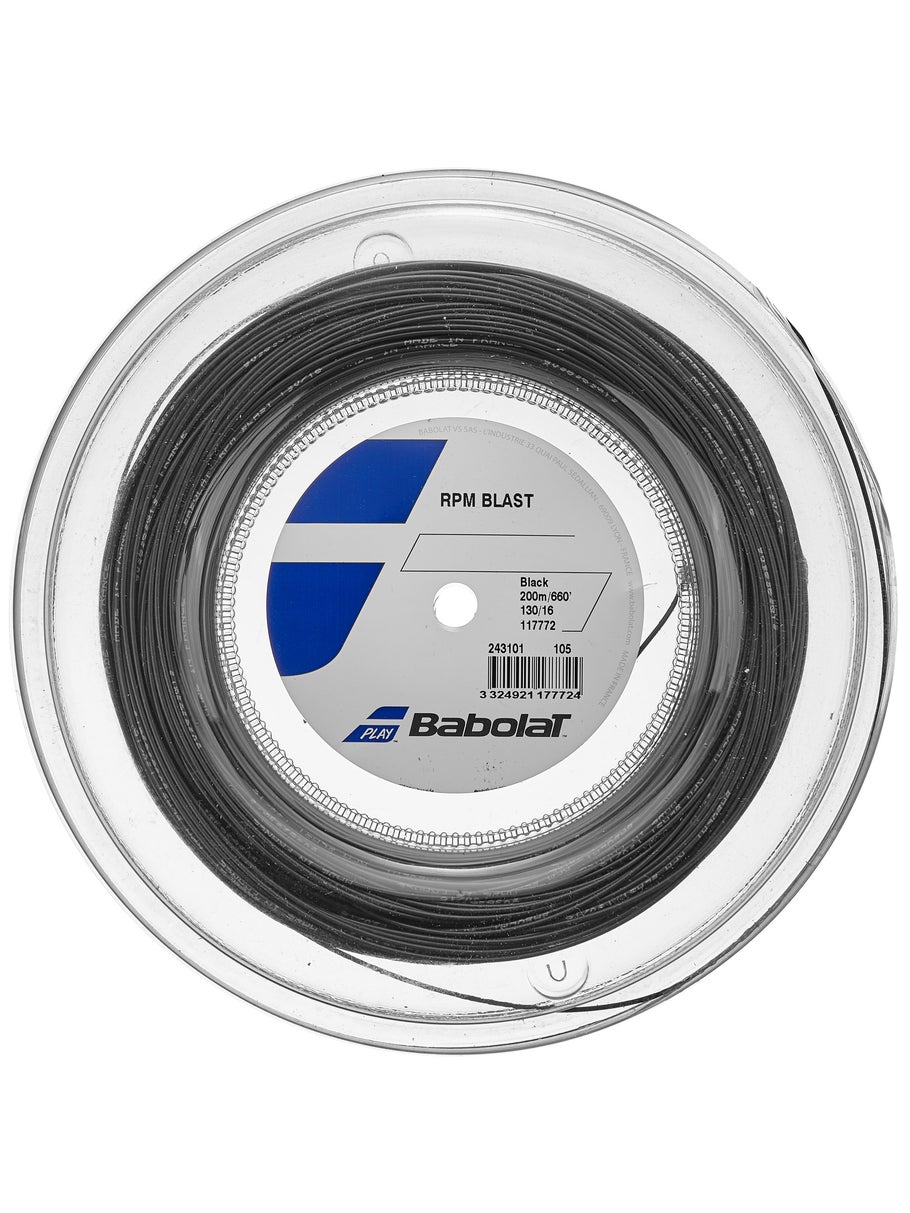
|
String of the Clay Generation
Babolat RPM Blast 17
1.25mm · Octagonal Co-Poly · Low-Power, High-Spin, Firm Response · Black
This is the least flashy recommendation On Serve has made. RPM Blast has been on the market since 2009. The trick — an octagonal cross-section that grabs the ball instead of letting it slide — has been copied by every other polyester maker in the years since. The price sits in the middle. The colour is black. There is no novelty case here. |
The case is what RPM Blast actually is on tour. Nadal played his entire career on it, in some gauge, with Babolat’s stringers running new beds before every match. Alcaraz hybrids it with VS Touch gut for a livelier feel. The pros who aren’t on RPM Blast are usually on something built to behave like it — Solinco Hyper-G, Luxilon Alu Power, Yonex Poly Tour Pro — strings whose lineage runs through this one. Sabalenka, on the women’s side, plays Luxilon Alu Power mains with a Luxilon Ace cross: same polyester family, different brand. Sinner, for the record, is on Head strings.
Mechanically: low-powered, firm, grips the ball, snaps back fast, rewards a fast racquet-head player who hits up and through. It’s built to produce a topspin first-strike forehand. A flat slap will sail. A defensive slice will float. A slow swing will produce tennis elbow within a fortnight. 17g (1.25mm) is the standard tour gauge — marginally livelier than 16g, marginally less durable than 18g.
Who it’s for: a 4.0+ club player whose game runs on topspin, whose forehand is the dominant shot, who plays on hard or clay, and who restrings every fifteen to twenty hours of play to keep the firmness from going dead. Who it’s not for: anyone with elbow trouble, anyone on heavy indoor hard courts, anyone whose game is touch and feel rather than depth and shape. For those players, a multifilament or a softer-crossed hybrid is the right call.
The honest reason to put RPM Blast in your racquet, if you’re the player it’s for, is to feel what most of the clay tour is actually working against. Nadal played two decades on this string. Most of the men’s draw at Madrid last week was on some version of it. There is something to learn from feeling that firmness under your own fingers.
Shop at Tennis Warehouse · $22 →