
| Issue 002 | Tuesday | 28 April 2026 |
On Serve
Sinner is the only protagonist Madrid has left.
Alcaraz is out with a wrist. Djokovic is out with a shoulder. The Caja Mágica’s marquee names this fortnight come down to one — and the one has never won the place.
|
667
Metres Above Sea Level at the Caja Mágica
|
0
Sinner’s Career Madrid Titles Before This Week
|
3
Sinner’s Masters 1000 Titles in 2026 — Tour-leading
|
The Caja Mágica is staging a tournament without two of the three men a Madrid 2026 broadcast was supposed to be about. Carlitos Alcaraz, the two-time former champion who lives three hours south, is at home nursing a wrist injury. Novak Djokovic, who has more career silverware here than any man alive, is out with a shoulder. Whatever else this week becomes, it is no longer a referendum on the Sinner-Alcaraz rivalry. That argument has been postponed, by the bodies of the men holding it, until Rome.
What it is instead is the cleanest opportunity Jannik Sinner has yet been given to win a tournament he has never won. He has played the Caja Mágica three times before this week. He has made one semifinal. He has not, until now, walked in as both the world No. 1 and the obvious favourite, with the only two men ranked alongside him sitting out the same fortnight for unrelated reasons. The trophy and the asterisk arrive together.
The numbers around him are large enough to deserve repeating. Three Masters 1000 titles in 2026 already — Indian Wells in March, Miami without dropping a set, Monte-Carlo over Alcaraz a fortnight ago — make him the first man since Djokovic in 2015 to win Indian Wells, Miami, and Monte-Carlo in the same calendar year. The Italian’s clay credentials, as recently as a month back, were the open question of the season. They are no longer open. He is 2-3 against Alcaraz on clay over their careers, 7-10 overall, and the most recent two clay meetings — Beijing-tier hard-court conditions notwithstanding — have both gone the Italian’s way.
The altitude tilts the surface in his direction, too. The Caja Mágica’s 667 metres of elevation make the ball move faster and sit higher than at any other clay event on tour, which is the polite scientific way of saying the Madrid surface rewards exactly the kind of game Sinner has spent the last six months perfecting: flat, early, vertical, taken on the rise. The history of the tournament is full of upset winners — Auger-Aliassime nearly took Rublev to a third the year before last; Casper Ruud actually got it done last May, beating Jack Draper for the first Norwegian Masters 1000 title in tour history — but the upsets tend to come from inside the same family of players Sinner now most closely resembles. Madrid has, for a decade, been the clay event the flat-hitters can win. The flat-hitter at the top of the rankings has not yet won it.
Two ways to read what’s coming. The reading where Sinner runs through a thinned draw, lifts the trophy, and arrives at Rome with four Masters 1000s already in 2026 and the men’s tour rearranging itself around him in earnest. And the reading where altitude proves a leveller in the wrong direction — kicker serves go nowhere, opponent forehands fly off the strings, and the trophy goes to a Ruud or a Khachanov or a young Fonseca who has nothing to lose and a Caja Mágica that suddenly belongs, for one fortnight, to the player nobody saw coming.
Whichever reading is right, the men’s tour will be different at Roland Garros in five weeks than it looked at Roland Garros last year. We are watching that change, in real time, in the absence of the men who would have argued hardest against it.
What the thin air is allowed to be.
There is a specific complaint, repeated annually, that Madrid is not real clay. The complaint comes — depending on the year — from Djokovic or Nadal or some retired Spaniard now on a French television panel, and the complaint is, on its own terms, correct. The ball at the Caja Mágica behaves nothing like the ball at Roland Garros. It moves faster, sits higher, and forgives a kind of flat-hitting impertinence that Paris would punish and Rome would tolerate only on Tuesday afternoons against a wild card. Madrid is, by the orthodox definition, not really clay tennis.
Fine. But the orthodox definition is doing a lot of work. The orthodox definition assumes that “clay tennis” is a thing — a stable Platonic object, knowable and singular, whose proper performance can be measured against the surface it’s performed on. The trouble is that the object has never actually been stable. Clay tennis in 1978 — Borg wearing out the heavy wooden frame against Vilas while a Roland Garros crowd smoked through changeovers — is not the clay tennis of 1992, which is not the clay tennis of 2008, which is not the clay tennis of last weekend. Each generation invents the surface a little. Each generation’s geniuses install a new theory of what the dirt is supposed to do.
What’s interesting about Madrid is that it is the one stop on the calendar that makes the invention visible. Sea-level clay lets a player pretend the surface is doing the work. Altitude clay calls the bluff. The ball is moving too fast for the old habits to hold; the player has to choose, in real time, whether to remain a clay-court traditionalist or to become whatever it is the air is asking him to become. The Caja Mágica is, in this sense, a confession booth dressed up as a tennis stadium. Whatever you actually are as a player — flat, vertical, two-handed, defensive, opportunistic — Madrid will, over five rounds, ask you to admit it.
There is, this year, a second confession the tournament is quietly extracting, and it has nothing to do with anyone playing. The two men who have done the loudest annual complaining about Madrid not being real clay — the great Spaniard, the great Serbian — are both watching this week from their living rooms, declared unfit by parts of their own bodies. The tournament will run without them. The trophy will be presented to whoever is fittest enough to lift it. The thin air, undisturbed by either of its most famous critics, will spend nine days asking the rest of the field whether it minds. Most of the field, one suspects, will quietly admit it does not.
Long may the altitude keep asking the question.
Iga’s spring is coming apart, and three weeks is not long enough to fix it.
She fired her coach in March. She hired a new one in early April. She walked off a clay court in tears on Saturday afternoon. The renovation is being stress-tested in real time, and the building is making sounds nobody quite recognises.
For the better part of four seasons the Iga Swiatek scouting report was a single page, easily summarised, rarely updated. Heavy topspin forehand, a textbook two-handed backhand redirected up the line, the most punishing return on the women’s tour, footwork good enough that the third stroke of any rally lived inside her strike zone whether the opponent meant to put it there or not. Roland Garros 2020. Roland Garros 2022. Roland Garros 2023. Roland Garros 2024. Wimbledon 2025. The page never had to grow.
It is being rewritten now, in something close to real time, by a Polish player who has not won a tournament since last summer and a Spanish coach who has been on the job for twenty-four days.
The Wim Fissette partnership ended after a second-round loss at the Miami Open in March, the kind of result that does not, on paper, justify a coaching change of this size. On paper is not where the change was made. Iga had spent sixteen months looking, by her own standards, like a player thinking through her shots rather than playing them — a long renovation Fissette had been quietly conducting, and which the two of them had presumably agreed to commit to, until Miami offered the kind of evidence neither of them could carry into the clay swing without addressing. By 2 April she had been seen training at the Rafa Nadal Academy with Francisco Roig, who spent seventeen years as Nadal’s lieutenant from 2005 to 2022 and is, on the face of it, the most overqualified emergency hire the women’s tour has produced in some time.
Roig’s first tournament with her was Stuttgart. Iga opened the week well, dispatching Laura Siegemund 6-2, 6-3 in 90 minutes — five breaks of serve, twenty-two winners, 78 per cent first-serve points won. Then Mirra Andreeva, eighteen years old and now a player who beats her routinely, took a 3-6, 6-4, 6-3 quarterfinal that came down to break-point conversion. Andreeva saved nine of fourteen break points she faced. That is not an opponent slipping; that is an opponent solving Iga’s main weapon and leaving her with nowhere else to go.
Madrid, this week, has been worse. A 6-1, 6-2 dismissal of Daria Snigur in the second round looked like the old Iga for an hour. Then Ann Li — ranked outside the top forty, no obvious clay credentials, the kind of opponent the old Iga handled inside seventy-five minutes — took the first set 7-6, dropped the second 6-2, and was up 3-0 in the third when Iga walked to the chair, called for the doctor, and retired in tears. The injury, whatever the medical explanation turns out to be, cannot be the entire reason. A player of Iga’s standing does not ordinarily lose a third set on her chosen surface to Ann Li.
The trouble Roig has been hired to fix is unfortunately the trouble that takes the longest to fix. Iga is not, as far as anyone watching her can tell, hitting the ball badly. She is hitting the ball with someone else’s intention attached to it — Fissette’s longer-renovation intention, then Roig’s not-quite-installed-yet intention, neither of them fully her own. On a ball machine this is harmless. On a clay court at the Caja Mágica against Ann Li, with a tournament point at stake and the Roig partnership three weeks old, it is the kind of indecision that ends in retirement and a long quiet evening at the team hotel.
The bull case is worth saying out loud anyway, because Iga at her ceiling is still the best clay-court player of her generation, and the generation has not produced a clear challenger. Aryna Sabalenka’s clay numbers are improving but have not crossed into dominant. Coco Gauff at Roland Garros 2025 was the most plausible threat, and even that was a final, not a takeover. The seat at the top of the women’s clay swing is still nominally Iga’s. The only thing she has to do, between now and 24 May when Roland Garros begins, is sit in it again.
Roig will not finish the renovation in five weeks. He may, however, get her arguing with herself in the right way again. After the spring she has just had, that would already be most of the way home.
The Djokovic shoe goes on sale. The man himself is at home with a shoulder.
|
Designed With Djokovic
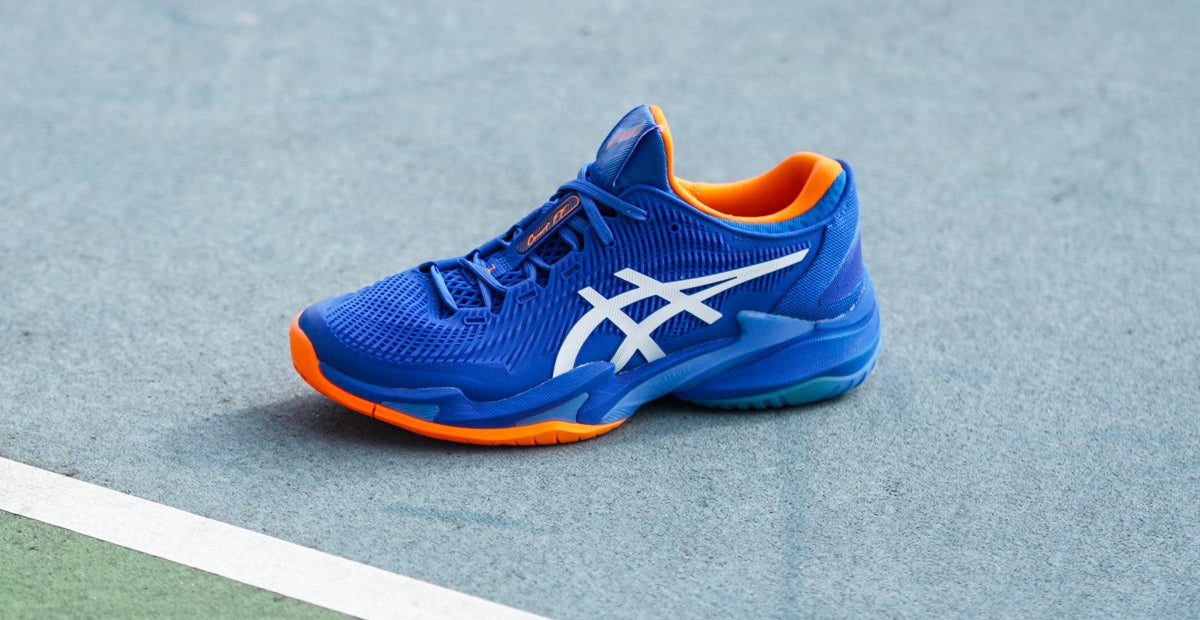
Asics Court FF 3 Novak Clay
14.5 oz · FlyteFoam Midsole · Twistruss Support · Mono-Sock Construction · Herringbone Clay Outsole
There is a small irony to recommending Novak Djokovic’s signature shoe in a week he is not playing, with a shoulder injury keeping him off the tour for the third extended absence in fourteen months. The shoe does not know any of that. The shoe is exactly what it has been since Asics released it in 2023: a thin, aggressive, low-to-the-ground court shoe designed by a man who slides on every surface and asked his footwear company to give him a sole that would let him keep doing it without breaking an ankle. |
Nine prototypes, the company will tell you. Djokovic tested all of them across most of a season before the production version was finalised. What he ended up with, and what is on the Tennis Warehouse listing this week, is a shoe with three separate outsole pieces — split, the engineers will say, to flex independently with the foot’s movement during a slide — a Twistruss support system that has been re-cut into two pieces for finer torsional control, and a Mono-Sock construction that wraps the foot like a low-cut ankle brace and is, as a consequence, slightly difficult to put on. If you have wide feet, this is not your shoe. If you do not, it is the closest thing on the retail market to wearing a tour player’s preferences.
The Clay version of the Court FF 3 Novak is the one to buy, regardless of where you usually play. The full herringbone pattern sheds clay properly. The forefoot is reinforced where players who slide a lot wear through; the medial toe-box has the PGUARD strip Asics borrowed from its all-court line three generations back. The slide itself — the part of clay-court tennis that recreational players spend years failing to learn — is the closest a shoe is allowed to come to teaching it for you.
What it isn’t: a shoe for a heavy player who plays steady, percentage tennis and stays inside a narrow band of the baseline. The Court FF 3 Novak is built for a player who pushes off, stops late, and then pushes off again. That is Djokovic’s tennis. It is, increasingly, the tennis of any 4.5 who has spent six months trying to add a slide to their game. For the rest of the field — the 3.5s and the early 4.0s — the shoe is overcommitted. Save the $165, buy a Gel-Resolution X, and revisit the Court FF 3 Novak when your footwork has grown into it.
This is the shoe Djokovic will wear at Roland Garros in five weeks, when the shoulder, with luck, has healed. Whether he plays the rest of the spring or not, the design has earned its place in the bag of any player whose game already lives below the baseline and slides toward it.
Shop at Tennis Warehouse · $165 →