
| Issue 005 | Tuesday | 26 May 2026 |
On Serve
Paris on paper, before Paris turns into Paris.
The draws came out on Thursday and went, within the hour, from a piece of administrative arithmetic to a thing that thirty-two men’s and thirty-two women’s careers will be measured against for the rest of the season. The bracket is the first thing every Roland Garros becomes, and the last thing it stops being.
|
29
Match Winning Streak Sinner Carries Into Paris — Fifth-Longest of the Open Era
|
0
Defending Champions in the Men’s Draw — Alcaraz Withdrew 24 April
|
3
Championship Points Sinner Held Against Alcaraz in Last Year’s Final, the Longest in RG History
|
The men’s draw resolved into something closer to a coronation than a tournament. Jannik Sinner, the world No. 1, was seeded above a field that has been thinned at the top by the one absence that mattered. Carlos Alcaraz — defending champion, two-time winner, the player who beat Sinner from three championship points down in the longest final in this tournament’s history — has not hit a ball in anger since Barcelona’s first round on 14 April, where his right wrist gave out against Otto Virtanen. His team announced the Roland Garros withdrawal ten days later. He will not, on present medical timelines, be at Wimbledon either. The draw, made on Thursday, was constructed without him.
Sinner arrives at the venue he has never won carrying a 29-match winning streak, the fifth-longest of the Open Era, and a 36-2 record on the year. He has won the last three Masters 1000 events on clay — Monte Carlo, Madrid, Rome — and is the second man in history, after Nadal in 2010, to sweep the trio in a single season. His Rome title earlier this month completed the Career Golden Masters, all nine active 1000s collected, at twenty-four; the only other man to do it is Djokovic, who took until thirty-one. The R1 draw handed him the French wild card Clement Tabur, ranked 165 and twenty-six years old, in front of a Chatrier crowd that would prefer to win the point and lose the match in the most aesthetically pleasing way possible. On paper, his quarter clears with Bublik at No. 9 and Shelton at No. 5 — Sinner is 9-0 lifetime against Shelton — and the semifinal projects to fourth seed Auger-Aliassime, whose section is the most wide-open in the draw and contains Monfils, Cilic, Cobolli, Cerundolo, and Medvedev among others. The final, if seeds hold, is Zverev (the 2024 finalist) or Djokovic, in opposite halves and now in the same half as each other.
The cleaner statement of the men’s draw is that Sinner has the lighter half on paper — the bottom of the bracket, with three-time champion Djokovic and 2024 finalist Zverev on the same side, is the half that has to produce his final opponent — and the easier path within his own quarter as well. The Italian’s projected route is not the test he needs the tournament to give him. The test is whether he holds the favourite tag for fourteen days, in best-of-five, at a Slam he has never won, on the surface that took his last meaningful match into a fifth-set tiebreak.
The women’s draw is the more interesting bracket to read. Aryna Sabalenka, world No. 1, drew Jessica Bouzas in the first round and projects to a semifinal against Coco Gauff — the same Gauff who took the trophy here last year. Elena Rybakina is the second seed; Iga Swiatek, the four-time champion who has spent the spring restructuring her game under a new coach, is third and drew Australian wild card Emerson Jones in R1. Mirra Andreeva, nineteen and seeded eighth, leads the fourth quarter into a section that also contains Jasmine Paolini, the 2023 finalist Karolina Muchova, and the 2021 champion Barbora Krejcikova. The seedings say a core four. The draw, in honest reading, says one of eight. The Andreeva quarter is the quarter the broadcasters will not spend the first week explaining and the second week wishing they had.
By the time this issue lands in your inbox, the first round is largely done, and a name or two has begun to write itself onto the back of the bracket. The arithmetic resolves into tennis on Sunday. The paper is the asking. Roland Garros, between now and the second Sunday in June, is the answering.
On the qualifying tournament, which is the purest tennis you will not watch.
The qualifying tournament begins on the Monday of the week before Roland Garros, in the early sun of a Parisian May, on the outside courts of Stade Roland Garros that are not the courts you have ever seen on television. There are no cameras on most of these matches. There is no draw sheet circulated to anyone who has not paid the modest qualifying-week ticket price and walked through the gate. The crowds are the crowd of people who chose, on a Monday morning in the late spring, to spend a day at the tennis with a baguette and a bottle of water and no particular allegiance to any of the players whose names they did not, until that morning, know. The crowds are very small. The tennis is extraordinary.
There are reasons for the extraordinariness, and they are technical before they are sentimental. The qualifying field is one hundred and twenty-eight players, of whom sixteen will advance to the main draw. The players are, almost without exception, men and women ranked between roughly seventy and one hundred and eighty in the world — which is to say, professional tennis players of the very highest level, none of whom are quite good enough to be in the main draw on ranking alone, and most of whom are good enough to beat at least half of the players who are. The matches are best-of-three sets, played without the cushioning of a stadium crowd or the friction of a pre-match press conference, by players who know that three wins this week buys them a place in the main draw of a Grand Slam, with the prize money, the ranking points, the seven hundred and fifty thousand viewers, the post-match interview on French television, and the rest. Three losses, and the spring is over. They will not, most of them, qualify into the main draw of Wimbledon either. They will go back to the Challenger circuit, and to Czech towns and Brazilian towns and Thai towns where the prize money for winning a tournament outright is what a top-fifty player earns for losing in the second round here. The stakes, in qualifying, are at their most legible. The performances, accordingly, are uncluttered.
What is uncluttered about them is the absence of theatre. The players are not, at this rung of the ladder, sponsored by the watch brands and the airline alliances. The kits are mostly plain. The towels are tournament-issue. The on-court chair is the same on-court chair. The umpire, at qualifying, sometimes does not have a tournament-issue blazer; he wears a tournament-issue polo shirt. There is no Hawkeye on the qualifying courts. The lines are called by line judges, who, on the outside courts, will sometimes be retired French amateurs who play at the local club in the seventh arrondissement and have done so for thirty years. A disputed call is a disputed call. The players argue with their hands. There is no challenge system to retreat into. The tennis happens, and is judged, and is over.
What is also uncluttered is the length of the rally. Without television, without the broadcast clock, without the strategic pause for the slow-motion replay, the matches breathe at their natural tempo. The players take their time between points. They towel off. They walk to the back fence. They serve when they are ready, not when the chair has reminded them three times. Rallies of fifteen and twenty and twenty-five shots are not exotic and are not, the way they would be on a televised match in the second week, applauded by the crowd as an event. They are simply the way the points happen. You stand at the side of Court 14 and you watch two women you have never heard of construct a thirty-two-shot rally with cross-court forehands at a depth and a margin that would, on Chatrier, get them broadcast in slow motion, and the rally ends with a winner up the line and a small ripple of applause from the fifty people who happened to be standing there, and the next point begins, and the next point is just as good.
Three days of this. Three rounds. Three best-of-three matches against players ranked within twenty places of you, on the surface that suits some of them and undoes others, in a week that the main-draw players are still at home or already in Paris but still hitting at the National with two hitting partners and no audience. Sixteen of these one hundred and twenty-eight men and women will be in the main draw on Sunday. The rest will not. The tennis the rest play this week will be among the best tennis they play all year. It will be watched, almost in its entirety, by nobody.
The honest reason to come to Roland Garros on the Tuesday before the tournament starts is not the autograph queue at the National. It is the qualifying. It will not be on television. It is, in the truest sense, the only tournament at Roland Garros in which the tennis is the entire event. It is also, and not by coincidence, the tournament at Roland Garros that draws the smallest crowds and is mentioned, in the official Roland Garros yearbook, in a single paragraph at the back.
An art is, often enough, the form of a thing the audience has not yet noticed is the form of the thing. The qualifying is the art. The main draw is the opera.
Jannik Sinner is the heaviest pre-tournament favourite at this Slam since the late-period Nadal years. He has also, on the same court, lost the only championship points he has ever held there.
The world No. 1 arrives in Paris on a 29-match winning streak, with the last three clay Masters in his luggage and the defending champion absent from the draw. The question he is being asked is not whether he will win the tournament. The question is whether he is the right kind of favourite to win it.
The streak is the first fact and it is the easiest to misread. Twenty-nine matches sounds, in the abstract, like a runaway. It is, in the historical company it now keeps, the fifth-longest of the Open Era — behind only four streaks ever compiled on the men’s tour, all of them ended, eventually, at a Grand Slam. Sinner’s started at Indian Wells in March. It has carried him through Indian Wells and Miami on the hard courts and through Monte Carlo, Madrid, and Rome on the clay, with a 36-2 record on the year and an 8-1 record against players ranked in the top ten at the time of the meeting. He has not lost a set in any Masters 1000 final he has won, ever. He became, with the Rome title earlier this month, the second man in history to sweep the three clay Masters 1000s in a single season — Nadal, in 2010, was the first — and the youngest player ever to complete the Career Golden Masters, all nine active 1000s, at twenty-four. Djokovic was the only previous man to manage it. Djokovic was thirty-one when he did.
| ATP Ranking | No. 1 |
| 2026 ATP Record | 36–2 (94.7%) |
| 2026 vs. Top 10 | 8–1 |
| Career Roland Garros Titles | 0 · Runner-Up, 2025 |
| Career Roland Garros W–L | 22–6 |
| Career Grand Slam Titles | 4 · AO ‘24, US ‘24, AO ‘25, W ‘25 |
| 2026 Masters 1000 Titles | 5 · IW, Miami, MC, Madrid, Rome |
| Current Winning Streak | 29 · Fifth-Longest, Open Era |
| Sets Dropped, Masters 1000 Finals Won | 0 (career) |
What the numbers do not say is that he was three championship points from holding the Coupe des Mousquetaires last June and watched it leave the room. The 2025 final, against Alcaraz, ran five hours and twenty-nine minutes — the longest in this tournament’s history. Sinner served for the title at 5-3 in the fourth set. He held three championship points in that game. He did not convert any of them. Alcaraz broke back, took the fourth set in a tiebreak, then the fifth in a champions-tiebreak at 10-2, becoming the third man in the Open Era to save a championship point en route to a major trophy. The match has been called, by people whose job it is to compare these things — McEnroe, Courier, Henin, Mauresmo — the greatest Grand Slam final of the present era. Sinner has not, in any interview since, said anything about it that is not gracious. He has also, on the evidence of the spring, not stopped playing tennis since.
The historical parallel that travels best for what is now in front of him is not Nadal in 2022, the gimpy-foot defending champion arriving cold. It is Federer in 2009 and Nadal in 2010 — two players who arrived at a Roland Garros they had not yet won, found the surface’s gatekeeper unable to play, and converted the opening into a Career Slam (Federer) or the most dominant clay season of the decade’s first half (Nadal). Federer’s 2009 had Söderling do the gatekeeping for him; Nadal’s 2010 had nobody at all who could match him, and he won the trophy without dropping a set. Sinner is in the same room with both of those weeks now. The door has been opened. The question is whether he walks through it the way the door wants him to.
What argues for him is everything the spring has argued for him. The serve, on the slower European clay, has been more reliable than on hard courts — fewer doubles, the first-strike rate held above his career average through Monte Carlo and Madrid, the second-serve points-won figure best of his career. The backhand down the line, which is the shot the broadcaster always shows because it ends rallies prematurely, has been the rally-shortening tool the slow surface usually neutralises. The movement looks, to the eye that has watched him for four years, the most settled it has ever been. He does not slide reluctantly the way he did at twenty-one. He arrives at the ball, sets, hits through, slides into recovery, repeats.
What argues against him is that he is the favourite. The last time Sinner held a championship point in a Slam final on this court — last June, against the player now sitting the tournament out — he did not convert it. He has, in the eleven months since, won a Wimbledon final off the same opponent and lost an Australian Open final to him. The favourite tag at Slams has produced, on the present sample, a record that splits both ways. Best-of-five against an inspired opponent on a court that gives the inspired opponent the time to be inspired is the structural test the favourite tag puts in front of him for two weeks. The opponent who could put that test in front of him at this tournament is, in the present bracket, Djokovic in the final — the only player in the draw who has won Roland Garros more than once and is still capable of doing it again. Whether Djokovic is that player in May 2026 is the question the bottom half of the bracket will spend the second week answering.
The reading that travels best, three days into the tournament, is that Sinner will not lose this Roland Garros to anyone other than himself or Djokovic, and the bracket has been kind enough to put the Djokovic question off until the second Sunday. The first week is logistics. The second week, on the present form lines, is the most plausible run to the title we have seen at this tournament since Nadal’s last one. The trophy that was three points away last June is now thirteen days away. The streak that started in March is the longest of his career. Roland Garros is the only one of the four Slams missing from his cabinet — he holds two Australian Opens, the 2024 US Open, and the 2025 Wimbledon — and a win this fortnight makes him the seventh man in the Open Era to complete the Career Grand Slam, after Laver, Agassi, Federer, Nadal, Djokovic, and the twenty-three-year-old who collected the same set in Melbourne in January and is now, by an irony the calendar handed all of us, watching it from a sofa in Murcia.
The door has been opened before, for other players, in other Mays. Some of them walked through. Some of them did not. The tournament that begins this week is the one that will tell us which kind of fortnight Sinner is in.
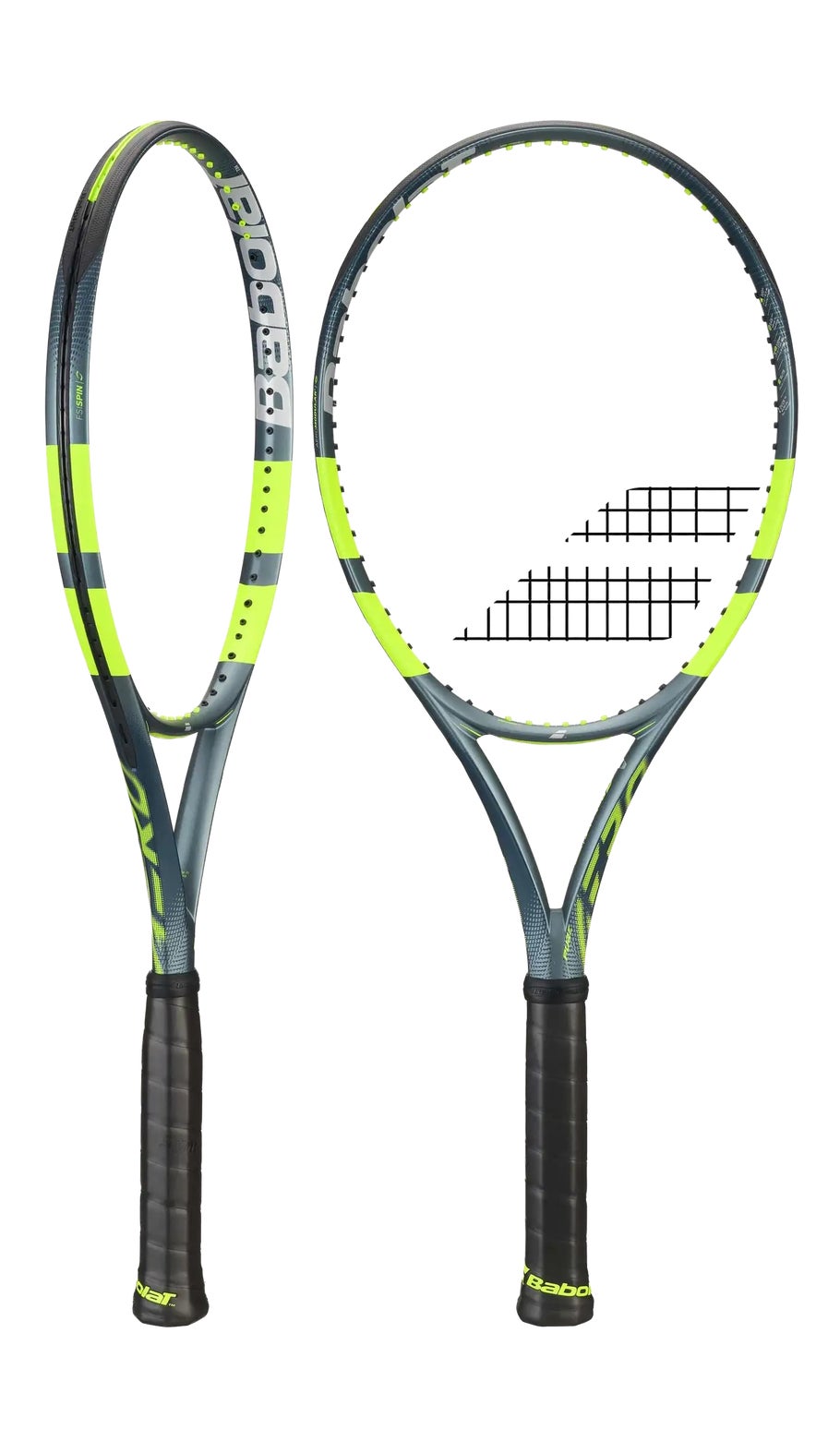
The Babolat Pure Aero (2026) — the racquet most people will never use as it is meant to be used.
|
The Frame the Surface Was Built For
Babolat Pure Aero (2026, 9th Gen)
100 sq in · 300g (10.6 oz) unstrung · 16×19 · 23/26/23 mm beam · 320 swingweight strung · RA 68 strung · 4 pts head light · NF2 Tech flax-fibre dampening · throat geometry redesigned (6% more aerodynamic)
This is the racquet a generation of clay-court players has been raised on, and the racquet most of those players, when they pick it up, do not swing the way the racquet was designed to be swung. This is the honest paradox of the frame. |
Tour use: Confirmed — Felix Auger-Aliassime (Pure Aero 100), Leylah Fernandez (Pure Aero 100), Carlos Alcaraz (Pure Aero 98 — different head size, same line). Reported — fourteen Pure Aero users in the ATP top hundred, more than any other frame on the men’s side. The Pure Aero is the highest-selling adult performance racquet on Tennis Warehouse’s clay-court demo list, year after year, and has been for most of the past decade.
The Pure Aero is the most popular adult performance racquet on the planet, sold to club players who want to feel the topspin a tour player generates, and it is also a frame whose engineering rewards a very specific swing pattern that most of those buyers do not have. The swing the frame wants is the swing Nadal made famous. Long, low-to-high, finishing over the opposite shoulder. The racquet head accelerating through the contact zone at, on Babolat’s own measurements for the 2026 update, three per cent more RPM than the 2023 model — the new throat geometry reduces drag by roughly six per cent, on Babolat’s wind-tunnel data, and the player feels it as a frame that wants to be swung faster than the previous version asked you to.
The string bed, on the FSI Spin pattern, has wider spacing in the upper main strings, which lets the strings move at contact and snap back, generating the spin number Babolat sells the frame on. The 23/26/23 mm beam is aerodynamic — the late-2000s “AeroModular” wing-shaped throat, refined nine generations now, cut for less drag through the hitting zone, allowing the swing speed to climb without the player feeling like they are dragging the frame through the air.
What’s new for 2026 — the ninth generation of the line — is the throat redesign described above and the second-generation NF2 Tech, which uses flax fibres in the layup to dampen the vibration on contact. The longstanding criticism of the Pure Aero — that on a flat hit it transmits more shock through the handle than a softer frame in the same category — has been the criticism Babolat has spent two generations addressing. The 2026 update is the version where the criticism is, in honest demo reports, largely answered. It is not a Clash. It does not pretend to be one. It is, however, the most comfortable Pure Aero ever sold at retail, and the RA of 68 strung sits in the middle of the modern racquet market rather than at the firmer end where the previous generation lived.
Who it’s for: a 4.0-and-up player whose game is built around topspin baseline tennis and who wants the frame to amplify the swing they already have. The player who hits a heavy forehand and a heavy two-handed backhand, who lives between the baseline and a meter behind it, who slides into shots on clay, who wants the ball to leave the strings with the kick most easily generated on the rise. The Pure Aero, on Tennis Warehouse’s own demo data, is the most-demoed frame in the under-thirty bracket; it is also among the most-returned, by players who pick it up off the shelf and discover that the frame is unforgiving on a flat hit. The frame is a topspin tool. Used as one, it is the most efficient spin generator on the market at the price.
Who it’s not for: a flat hitter. A traditionalist. A player who likes the Pro Staff’s plush response on a clean strike. A serve-and-volley player. A player whose forehand swing finishes at waist height; the Pure Aero will, for that player, feel like a frame that punishes the swing rather than rewards it. If your forehand finish is not over the opposite shoulder, the racquet is not, for you, the frame the marketing video promises.
The honest reason to put a Pure Aero in your bag this spring, for the player it’s for, is that it is the most coherent expression of topspin-baseline tennis available at retail. It is the frame the surface this fortnight rewards more than any other. It is the frame that, for the recreational player whose game runs on the same spin-and-depth proposition the tour does, gives the most direct translation of effort into result. It is also, for the player whose game does not run on that proposition, the most expensive way to feel like a worse player than you actually are. Demo before you buy. Hit twenty forehands. If the ball is leaving the strings with the kick you want, it is the frame. If it is not, the frame across the wall — the Pure Drive, or the Pure Strike — is closer to your game than this one.
Shop at Tennis Warehouse · $269 →| OS |