
| Issue 001 | Sunday | 26 April 2026 |
On Serve
Sinner took Monte Carlo by refusing, politely, to play clay-court tennis.
First trophy on the terra rossa since 2022 — and it didn’t look a lick like clay, which was precisely the point.
|
22
Consecutive Masters 1000 Match Wins
|
4
Straight Masters 1000 Titles — Djokovic, Nadal, Now Sinner
|
3
Years Since His Last Title on Clay
|
The scoreboard, bless its terse little heart, read Sinner 7-6(5), 6-3 — tidy as a Savile Row lapel. The match itself was a messier business altogether. What unspooled across two sets above the glittering Mediterranean last Sunday was nothing less than a gentleman’s quarrel over what clay-court tennis is supposed to look like in 2026, and the received wisdom — that grand old dowager — got shown the door in straight sets.
The tale we’ve been telling ourselves goes roughly like this: the lanky young Italian wins on hard courts because he’s flat and fearless and meets the ball early, and loses on clay because clay belongs to the topspin grandees hitting crosscourt from somewhere out near the photographer’s pit. It’s a lovely story. It is also, as of Sunday afternoon, about three years past its sell-by date.
Here, in the plainest prose I can muster, is what the redhead from San Candido did. He stood on the baseline. He took the ball on the rise. He committed, cheerfully, every last sin the clay-court catechism forbids in the presence of a player like Alcaraz — and the terra rossa, scandalized to its very core, declined to punish him for any of it. Carlitos earned four break points across the afternoon and cashed precisely zero. That isn’t clay-court tennis. That’s hard-court tennis with a tan and a view of the yachts.
The hinge of the whole affair came in the first-set tiebreak, Sinner down three-five. Pressure point, red clay, the bells and the whistles — exactly the spot where the surface, we had been promised, would assert its ancient authority. It did no such thing. Sinner took four of the next five points and never again looked like a man in jeopardy. Four consecutive Masters 1000 titles now for young Jannik, a 22-match Masters 1000 win streak trailing behind him like bunting at a county fair, and membership in a very exclusive little club — four or more Masters titles in a row — whose entire roster, prior to this week, consisted of one Novak Djokovic and the King of Clay himself. Not a list one wanders onto by accident.
Two ways to read the thing. The prudent reading: one match, the Spaniard was playing his fifth hard-court tournament in ten weeks, wait and see what the Caja Mágica has to tell us. The bolder reading: Sinner’s ceiling has shifted upward, the old clay gap has quietly, irrevocably closed, and Roland Garros for the first time since 2022 is a genuine two-man affair rather than a Carlitos coronation awaiting its date on the calendar. The honest answer sits somewhere between — closer, I’d wager, to the second than anyone currently flying the Spanish flag is prepared to admit at full volume.
Monte Carlo is the last aristocratic stop on the calendar.
There’s a particular kind of European seriousness that exists only at Monte Carlo, and it has nothing to do with the tennis. It has to do with the fact that nobody in the stands is wearing a team jersey. The crowd watches the way an opera crowd watches — politely, knowledgeably, and with the quiet understanding that showing too much enthusiasm would embarrass everyone involved.
Which is, of course, ridiculous. It is also why Monte Carlo is the best-feeling tournament of the year on television. The silence between points isn’t dead air. It’s attention. Compare it to a night match at Ashe, where a phone rings in the third row and the chair umpire has to ask for quiet twice before the server can even toss, and you begin to see why the European clay swing still carries a weight the hard-court circuit gave up on somewhere around 2005.
The tournament also has the cliff. The country club is built into one, the Mediterranean sits behind the baseline of Court Rainier, and once an hour or so the broadcast remembers to give you the crane shot that reminds you why the players chose this life in the first place. You watch Muscles-era footage from the seventies and the venue is the same. You watch next year’s final and the venue will still be the same. That’s not nothing. That is, in fact, most of what a tennis tournament actually is.
None of this is coming back. The sport is globalizing into something louder and more American and more crowded with sponsor activations, which is fine, and probably correct, and certainly profitable. But once a year, for seven days in April, tennis remembers it used to be a different thing. A quieter thing. A thing that happened at four in the afternoon on a red clay court while a few hundred people watched without applauding between first and second serves. Long may that week continue.
Carlitos has a problem nobody much wants to say out loud.
He’s all of twenty-two, already clutches a Career Slam to his chest, and has just dropped three in a row to Sinner. That last bit is new. It matters.
Eight weeks ago, the Alcaraz bear case simply did not exist. The boy from Murcia — Carlitos of the eyelashes and the sprinter’s first step — had taken the Australian Open in February to complete the Career Grand Slam at an age when a fair share of American college freshmen are still negotiating with their coaches about whether turning pro might embarrass the family. He’d started the season a spotless 16-0. He’d returned to No. 1. There was no bear case. There was only the pleasant parlor game of guessing how tall the eventual legacy would grow.
Then Medvedev beat him at Indian Wells. Then Sinner beat him in the Miami final. Then Sinner beat him again in Monte Carlo. Three losses in six weeks, each administered by an opponent doing the same conspicuous thing to him: flat, early, vertical. Not more topspin. Not more scrambling. The very opposite of what the Alcaraz game was supposedly designed to dismantle. And — here’s the thing — it is working.
The pattern beneath the losses is this. Across all three defeats, Carlitos’s first-strike numbers — points won within four shots of his own serve — have slipped meaningfully off his 2025 averages. The serve itself is fine, sturdy as ever. The trouble sits on the +1, the stroke immediately following the serve, the stroke that since that charmed Umag run in the summer of ’22 has been the very motor of the Alcaraz game: a belted forehand into the open court, a whippy inside-in drilled at the backhand corner, an impudent drop shot whenever the returner plants himself too deep. When the +1 does its work — winner or setup — the kid is the best player drawing breath. When the +1 comes back as a neutral rally ball, he becomes — and this, friends, is new — merely very good. On a tour this deep, merely very good is a dangerous neighborhood to live in.
What Sinner did at Monte Carlo was take the +1 away. He accomplished it by standing on the baseline, of all the audacious places, and returning up the middle of the court, deep. Sounds dull. Was dull. Was also devastating: when Alcaraz’s first swing must be a neutral ball, his shot tree shrinks from five healthy branches to two scraggly ones, and he winds up playing his opponent’s tennis instead of his own. Which, for a young man accustomed since age eighteen to dictating terms, is a brand-new and decidedly unpleasant sensation.
The tell, if you’re collecting them, was the drop shot. On clay. Against an opponent whose one agreed-upon weakness — since always — is defending them. Alcaraz went to the drop five times Sunday. It worked twice. Those aren’t numbers that are supposed to happen; they only happen when the setup ball isn’t hard enough or early enough to pin the opponent deep. Sunday, it wasn’t.
None of this, let me say plainly, amounts to a crisis. Carlitos will almost certainly win Madrid. He’ll almost certainly win Rome — or come close enough that losing won’t much matter. He’ll arrive at Roland Garros the favorite and he’ll very probably win it, because across seven best-of-five-sets matches over a Parisian fortnight on the slowest surface in the sport, his ceiling is still the highest of anyone alive. But the question of whether Sinner remains merely the second-best player in the world — or has, across one spring, caught Carlitos altogether — that is suddenly, vividly, a live question. The next six weeks promise the most absorbing stretch of men’s tennis since Wimbledon 2008. I do not, for a moment, write that lightly.
The Prince Original Graphite is back. It shouldn’t work. It does.
|
Back in the Bag
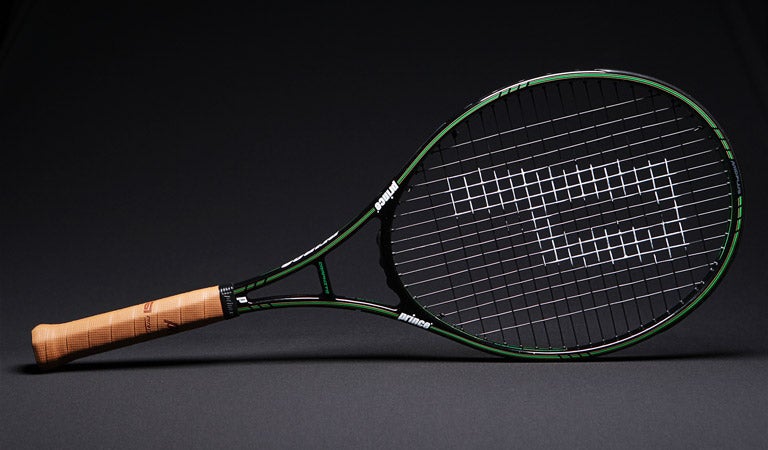
Prince Original Graphite 107
107 sq in · 354g strung · 16×19 · 65 RA · Classic Box Beam
First released in 1980. Swung, across its several iterations, by Michael Chang on the Bois de Boulogne during that unforgettable 1989 footrace past Lendl; by a teenage Andre Agassi before the Donnay chapter; by Sabatini of the ponytail and the killer forehand; by Monica Seles when Monica was terrorizing the tour two-fisted from both wings; and by roughly half the Florida and Texas junior academies across the Bush Senior years. Discontinued in 2016. Resurrected — gloriously, unexpectedly — by Prince in 2023 for the brand’s 50th anniversary. The reissue sold out twice faster than Prince had forecast, so back it came a third time. The spec sheet is honest to the original: same box beam, same crossbar stabilizer, same oversize head, same magnificently ludicrous full weight. The only absentees are the foam grip and the patience required to swing the thing. |
Why any of this matters: the racquet market has passed two solid decades optimizing for precisely one proposition, which is making it easier for a recreational player to hit a topspin forehand from six feet behind the baseline. Lighter frames. Stiffer layups. Open string patterns. Sweet spots nudged toward the tip. The Graphite 107 does none of that. It is heavy, it is low-powered, it demands early preparation, and it punishes late contact the way your old club pro used to punish late contact, with a single raised eyebrow and the word again. In 2026, delightfully, the frame is a counter-cultural object.
Which is exactly why it works. The plowthrough on a redirected ball — that wonderful, honest sense that you are hitting the ball rather than flicking at it — is something no current retail frame produces, because no current retail frame weighs 354 grams strung. The slice backhand drives through the court the way slice backhands drove through the court back when Mac was still winning doubles matches in his sleep. Volleys feel like volleys for the first time in about fifteen years of retail racquet engineering. The trade-off — and there is always a trade-off — is that you must be an actual tennis player to hit with the thing. There is no technology to hide behind. There is, to be clear, no technology at all. For an improving 4.0 with coached footwork, six months with this frame will teach you more about the contact point than six years with a Pure Aero.
One plainspoken caution. This isn’t a racquet for everyone, and Prince is gentleman enough not to pretend otherwise. If your swing is short, if you’re a grinder by disposition, if you don’t relish taking the ball early or can’t generate your own pace — you will hate it. It will feel like swinging a hammer. If that description fits and the nostalgia is tugging you in anyway, the sensible move is to hunt a used original on eBay for $90 and leave the $270 reissue for the folks who’ll actually play with it.